

Explore international reviews of Monaldi and Sorti, alongside interviews published between 2001 and 2008. This selection highlights the qualities of their fiction: distinctive prose, narrative invention, humour and vividly realised historical worlds.
The archive covers Imprimatur, Secretum, Veritas and the novels of Salaì. Discover more about the writers on the About the Authors page.
Each entry retains the original article title, publication and available date. Follow the title to read the original press scan. PDF files are marked and include searchable text: use your reader’s Find function to look up words or names.
Press anthology 2001–2008 · Browse by year: 2008 · 2007 · 2006 · 2005 · 2004 · 2003 · 2002 · 2001
2008
Das Tacitus Komplott
Frankfurter Allgemeine Zeitung, 18-10-2008
Dirk Schümer praises the Salaì novel’s stylistic mastery and precisely judged comedy. His FAZ review compares its historical intrigue to The Name of the Rose and celebrates a picaresque voice recalling Rabelais, Cervantes and Grimmelshausen.
Gothic take on Innocent’s guilt (PDF)
The Australian, 24-5-2008
The Australian celebrates Imprimatur as an elegant Baroque construction, praising its superb writing and vivid evocation of seventeenth-century Rome. Frank Campbell highlights the novel’s exuberant humour, from sophisticated satire to broad comedy and slapstick.
A Papal mystery (PDF)
The Independent, 13-5-2008
Peter Popham’s Independent feature highlights Imprimatur’s rich evocation of seventeenth-century Rome. He praises a wealth of detail that repays the reader’s attention, while exploring the novel’s claustrophobic atmosphere, colourful cast and labyrinthine world of political intrigue.
Echoes of Eco (PDF)
The Times Literary Supplement, 02-5-2008
Jane Jakeman praises Imprimatur’s vivid language, enjoyable historical excursions and dazzlingly complex intrigue. Her Times Literary Supplement review also celebrates Peter Burnett’s English translation, highlighting the verbal inventiveness that brings the novel’s richly layered world of spies, music and secrets to life.
Vatican forced us out of Italy
The Daily Telegraph, 20-3-2008
The Daily Telegraph report traces the historical intrigue behind Imprimatur, introducing the castrato spy Atto Melani and the discoveries woven into its storyline. Monaldi and Sorti explain how documents they uncovered became part of their fiction.
Los casos del espìa castrado. Con Monaldi y Sorti en la misteriosa Viena, p.1,p.2
Que léer, 01-2008
Qué Leer portrays Monaldi and Sorti as intrepid literary adventurers, following them through the Vienna of Veritas. The feature explores the narrator’s changing role, his relationship with Atto Melani and the connected mysteries that link the novels into a larger story.
Staaltjes Italiaans extremisme
NRC, 22-1-2008
David Rijser’s NRC discussion presents Salaì as a Boccaccio-like rogue whose irreverent adventures cut Renaissance legends down to human size. The novel’s plot interweaves Leonardo’s misadventures with an alternative portrait of Pope Alexander VI in the Rome of 1501.
Los vestigios de la vida bohemia
La Razòn, 3-1-2008
La Razón explores how Atto Melani’s double identity and diplomatic intrigues animate Veritas. In this portrait, Monaldi and Sorti explain the narrative thread linking their projected seven volumes, with Vienna’s atmosphere and an unresolved imperial death shaping the story.
2007
Desvendar as mentiras da História (PDF)
Focus, 26-12-2007
An insight into the shared creative life behind Secretum: Monaldi & Sorti describe a passionate collaboration built on constant discussion and mutual revision. By exchanging and reworking their pages, they arrive at a voice in which neither can separate their contribution from the other’s.
“Vivemos numa época em que o leitor é o drogado da narrativa” (PDF)
Diário de Notícias, 22-12-2007
Monaldi & Sorti explain how suspense serves a richer historical narrative. Their attention extends to period language, characters’ ways of thinking and the smallest details of daily life, while imaginative invention works within the boundaries that make the fictional world convincing.
O trono manchado dos Bourbon (PDF)
Sol, 22-12-2007
An intimate glimpse of the partnership behind Secretum. Writing side by side, Monaldi & Sorti describe their books as shared creations, tracing how a historical puzzle becomes a novel and how their close collaboration shapes the stories they bring to the page.
Barroco ‘deluxe’ (PDF)
Visão, 20-12-2007
Visão praises Secretum’s finely written pages and ornate prose, presenting the Atto Melani novels as a generous cornucopia of art, music, politics and daily life. Courtly intrigue and Baroque atmosphere give this literary world its distinctive richness.
La otra Historia (PDF)
Iberia Universal, 20-12-2007
Iberia Universal presents Veritas as a rigorous, finely detailed historical novel whose intense detective plot draws readers into early eighteenth-century Vienna. Evocative settings, secret intrigues and Atto Melani’s investigations turn the period into a vivid narrative world.
La Viena barroca de Monaldi y Sorti, p.1, p.2
La Vanguardia, 19-12-2007
La Vanguardia introduces Monaldi and Sorti’s original strand of historical thrillers through the settings of Veritas. Its literary walk connects the novel’s murders, flying machine and narrator with the atmospheric palaces, taverns and imperial spaces of Vienna.
“Ficámos surpreendidos com as falsidades que se escrevem” (PDF)
Meia Hora, 17-12-2007
Monaldi & Sorti describe the craft behind their historical fiction: working from original sources to reconstruct authentic characters, settings, rumours and everyday details. The interview reveals how this attention to texture builds the historical world of Secretum, from its intrigue to the life surrounding it.
Interview: Monaldi & Sorti (PDF)
De Standaard, 14-12-2007
In this De Standaard interview, Monaldi & Sorti describe their ambition to entertain readers with an exciting story while inviting deeper exploration. John Vervoort introduces Salaì’s adventures as a boisterous picaresque tale, distinguished by its earthy, colourful narrative voice.
De zoon van Leonardo (PDF)
De Standaard, 14-12-2007
John Vervoort calls I dubbi di Salaì an entertaining historical novel and praises its vivid portrait of Rome around 1500. Salaì’s earthy, colourful letters frame an irreverent portrait of Leonardo and give the Renaissance adventure its distinctive narrative personality.
El Kaiser y la viruela: Monaldi y Sorti retoman su exitosa serie ambientada en el Barroco con Veritas
ABC, 10-12-2007
ABC highlights the historical precision behind Veritas, tracing how an imperial death sets its plot in motion. Its portrait of the novel connects Viennese palaces and taverns with interlocking Austrian, Ottoman and Spanish intrigues.
De domheid van Da Vinci
PZC, 6-12-2007
Mieske van Eck calls the Salaì novel a feast for readers who enjoy suspense, Italy, humour and playful eroticism. Her PZC review highlights the Boccaccio-like adventures of its epistolary narrator and the mystery sustained until the final revelation.
Da Vinci was ook maar een mens
Spits, 4-12-2007
Spits spotlights Salaì’s inimitable, entertaining letter-writing voice, with earthy language and gleefully unconventional phrasing. Through the incorrigible young rogue’s eyes, Leonardo becomes human, while spying, appetite and amorous escapades give the historical thriller its comic energy.
Interview: Thrillersauteurs Monaldi & Sorti over ‘The twijfel van Salaì’
HP De Tijd, 30-11-2007
In HP/De Tijd, Monaldi and Sorti explain their move from Baroque thrillers to Renaissance fiction. They describe how challenging familiar portraits of Leonardo and Alexander VI shaped their Salaì novel, making the interrogation of historical sources part of its design.
Monaldi y Sorti bucean en Veritas en la Viena del emperador José I
El Mundo, 29 Noviembre 2007
Laura Fernández praises the Atto Melani cycle’s seamless literary architecture and exceptionally detailed descriptions of period life. Her El Mundo feature follows Veritas into imperial Vienna, where the narrator’s reunion with Atto entwines personal adventure with the intrigues of 1711.
Krimi im Barock: Wann wird Joseph I. exhumiert? (PDF)
Kurier, 20 Oktober 2007
For Kurier, Veritas offers an unrivalled evocation of Baroque Vienna: how people lived, celebrated and died. It praises a spy novel that moves the reader while illuminating the past, and recommends it as historical fiction worth choosing.
Gift schmeckt nicht salzig, sondern bitter (PDF)
Süddeutsche Zeitung, 26 September 2007
The Süddeutsche Zeitung highlights the duo’s seamless shared voice, richly detailed storytelling and opulent period language. Its portrait shows two writers whose prose is so fully fused that readers cannot distinguish one author’s sentences from the other’s.
Wir zwei nirgendwo vernetzte Nullen (PDF), Von wegen: Bella Figura
Frankfurter Allgemeine Zeitung, 9 August 2007
The Frankfurter Allgemeine Zeitung introduces Monaldi & Sorti as a writing partnership of international stature. Its Vienna reportage explores their expansive Baroque storytelling, showing how forgotten places and historical dramas become living scenes in the imaginative world of Veritas.

Wie schreibt man zu zweit? (PDF)
Kurier, 15 Juli 2007
Kurier calls Monaldi & Sorti’s historical novels unrivalled, praising their extraordinary precision and the way researched history becomes fiction that opens the reader’s heart. The interview also reveals the mutual revision behind their remarkably unified literary voice.
2006
De waarheid vermoord
de Volkskrant, 27 Oktober 2006
Erik van den Berg introduces Veritas through Monaldi & Sorti’s commitment to documented history. The authors describe an approach in which real events and historical personalities supply the substance of the novel’s Baroque world.

De realiteit is spannender dan fictie
Artsenkrant, 27 Oktober 2006
Monaldi & Sorti explain how period details, social rituals and rediscovered music shape Veritas. Their conversation with Artsenkrant reveals a determination to inhabit Baroque Vienna’s distinctive rhythms and restore forgotten historical figures to narrative life.

Archieven liggen vol geheimen
De Tijd, 14 October 2006
In De Tijd, Monaldi & Sorti discuss the art of making another century feel inhabited. They describe building Veritas from authentic voices and social distinctions, with recovered music and historical personalities enriching the novel’s Viennese setting.

De geschiedenis dient herschreven
Gazet van Antwerpen, 6 October 2006
This Frankfurt interview introduces Monaldi & Sorti through reported praise for their brilliant, enjoyable fiction, before exploring their distinctive literary identity. The authors describe historical novels whose depth, language and style are deliberately their own.

Meelij met de verliezer. Monaldi & Sorti verbluffen met deel driel van een cyclus
NRC Handelsblad, 6 October 2006
NRC Handelsblad celebrates Veritas as a delight for lovers of Baroque fiction. Gert Jan de Vries praises its richly flowering language, surprising plot and renewed suspense, finding the storytelling tighter and its historical digressions more skilfully woven into the adventure.

Italie is niet gedient van nieuwe “Imprimatur”
NRC Handelsblad, 6 October 2006
This Frankfurt report foregrounds the translators who carry Monaldi & Sorti’s literary voice across languages. The authors describe close personal collaboration and careful attention to translated texts, treating translation as an essential part of bringing their novels to readers.

Het geheim van de gouden appel
Het Parool, 2 Oktober 2006
Het Parool explores Veritas’s play with disguise, performance and cryptic language. Atto Melani’s schemes draw the unnamed narrator into imperial Vienna, where a Turkish delegation’s mysterious reference to a golden apple sets the investigation in motion.

Warum ein Papst-Roman jetzt im Exil erscheint
Hamburger Abendblatt, 30 September 2006
Hamburger Abendblatt introduces Imprimatur’s international reach and invites its authors to explain the story’s foundations. Their account shows how secret seventeenth-century correspondence becomes the narrative engine of a novel about concealed loyalties, diplomacy and power.

Verboten: Der Krimi…
Kurier, 20 September 2006
Kurier traces the real documents behind Imprimatur’s web of intrigue, presenting a historical thriller built around secret financial dealings and divided loyalties. The report also records the novel’s international success and the Dutch publication of its Italian edition.

El poder se sostiene sobre mentiras
ABC, Martes 2 de Mayo de 2006
ABC explores the character-led craft of Secretum: Atto Melani provides the gateway to a meticulously recreated Baroque world. Monaldi & Sorti explain how food, clothing, characters and ways of thinking give their historical fiction its texture.

El secreto de la sucesiòn de Carlos II
National Geografic, May 2006
Historia National Geographic praises Secretum’s rich verbal craftsmanship, sustained intrigue and exceptional reconstruction of social life, from courts to everyday existence. It celebrates a distinctive historical and aesthetic journey, singling out the literary skill that holds the reader’s attention.

Una novela cuestiona la legitimidad historica de la monarquia de los Borbones
El Mundo, 27 de Abril de 2006
El Mundo highlights Secretum’s unusual narrative structure: a historical conspiracy unfolds into an investigative travel diary that invites readers to reach their own conclusions. Monaldi & Sorti describe fiction as a way of bringing complex discoveries to a wider audience.

Borbò il.legitim
Avui, 27 d’Abril del 2006
Avui highlights music’s central place in Secretum. Francesco Sorti explains how Baroque compositions enter the novel and its accompanying recording, allowing readers to encounter the sounds of its world alongside a story shaped around Rome’s decisive Jubilee year.

El “Secretum” se esconde en Roma. Los autores de “Imprimatur” cuestionan el testamento de Carlos II
Historia y vida, Abril 2006
Rafael Bladé praises Secretum’s exceptionally rich vocabulary and pleasurable narrative energy. His Historia y Vida review highlights the weaving of erudition, humour and interlocking intrigues, crediting the novel with complete immersion in its historical world.

2005
Rita Monaldi und Francesco Sorti
Stern, nr 45, 03 November 2005
Stern distinguishes Secretum from the season’s other thrillers through its unhurried storytelling and emphasis on atmosphere. The feature lingers on detailed Roman interiors, elaborate meals and the political manoeuvring surrounding Atto Melani in the Rome of 1700.

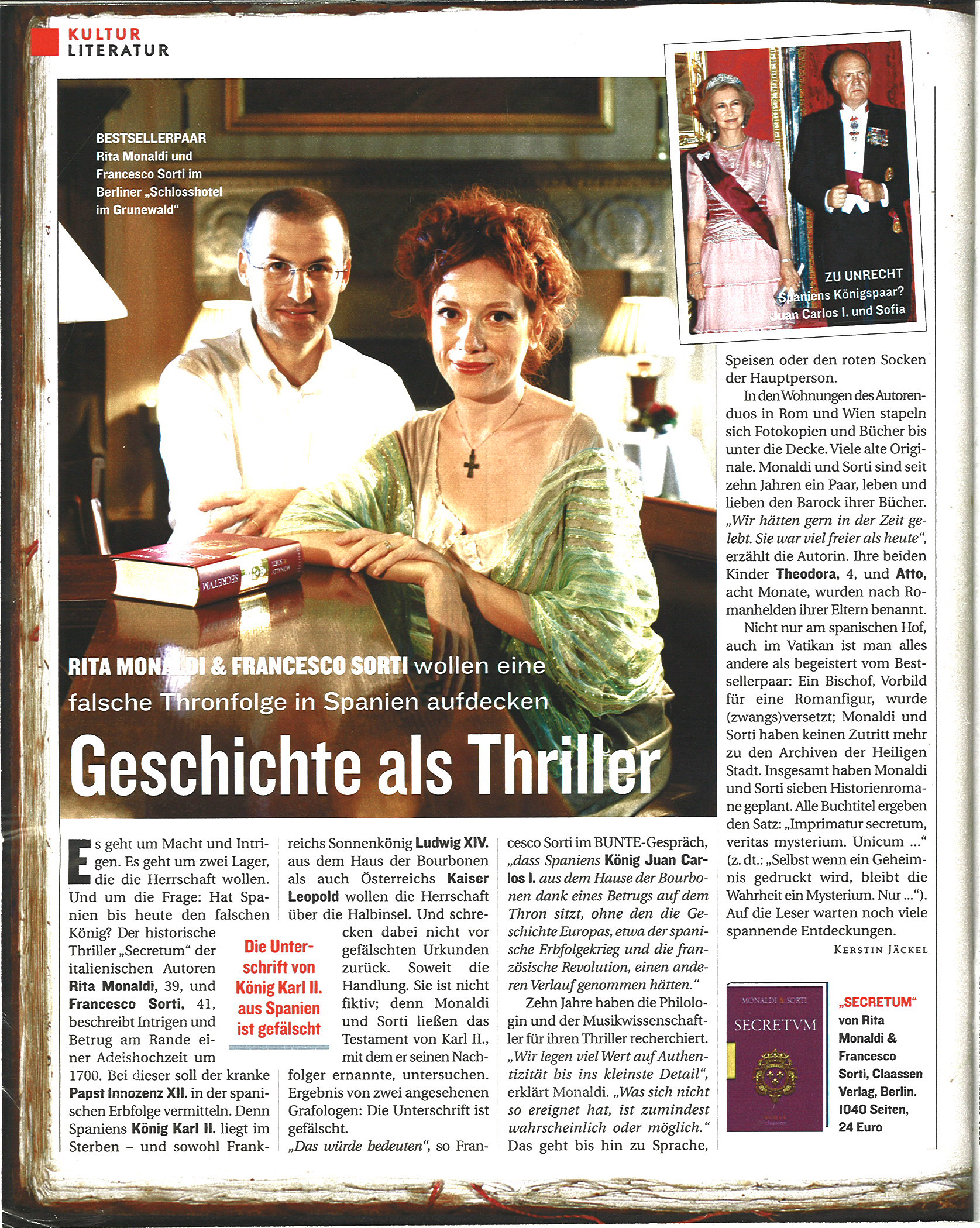
Geschichte als thriller
Bunte, 13. Oktober 2005
Bunte presents Secretum as a thriller of power, deception and rival dynasties, promising readers further exciting discoveries. Monaldi and Sorti explain how attention to language, food and even a character’s red socks gives their Baroque fiction its texture.
Intriges rond het sterfbed van een paus
Reformatorisch Dagblad, 6 April 2005
Wietske Nobel-Kroon acknowledges Monaldi and Sorti’s writing ability and singles out the moving story of Louis XIV and Maria Mancini. Her review also finds lasting interest in Secretum’s evocations of aristocratic splendour, political intrigue and corruption.

Vaticaans boycott Italiaanse schrijversduo
Gazet van Antwerpen, 8 February 2005
Martine Cuyt’s Gazet van Antwerpen feature introduces the seventeenth-century political intrigues behind Imprimatur and Secretum. Through an interview with the authors, it connects their plots about papal power and royal succession to the archival material on which their storytelling depends.

Jaque a un pontífice
La Vanguardia, 12 January 2005
Ernest Farrés calls Imprimatur an outstanding historical thriller that gives demanding readers everything it promises and more. His La Vanguardia review highlights its unusual seriousness and the combination of political intrigue, medicine, religion, astrology and Baroque music within its narrative.

“Imprimatur”: un gran exito editorial en Espana
Informacion e historia, January 2005
Información e Historia introduces Imprimatur through its abundant mixture of intrigue, investigation, conspiracy and love. The notice highlights how seventeenth-century Roman life, political alliances, alchemy, astrology and music combine within a plot built around a Vatican secret.

2004
Una novela històrica que triunfa en Europa
Clio, December 2004
In Clío, Monaldi & Sorti explain how Imprimatur’s fictional intrigue grows from precise period detail. They discuss authentic characters, daily life and the narrative possibilities of Baroque music, including the secret messages hidden within musical scores.

Tegelwijsheden
Rotterdams Dagblad, 2 December 2004
Rotterdams Dagblad calls Secretum a splendid literary historical thriller. Hans Maas showcases the witty maxims scattered through its mysterious Villa Spada, drawing attention to the novel’s aphoristic texture and the playful wisdom encountered by Atto Melani and his companion.

Sorti y Monaldi destapan la intrigas…
El Mundo, Martes 23 de Noviembre de 2004
El Mundo presents Imprimatur and Secretum as successful blends of historical fiction and the classic detective story. Monaldi & Sorti explain how Atto Melani becomes their investigator and how historical discoveries reshape the architecture of their plots.

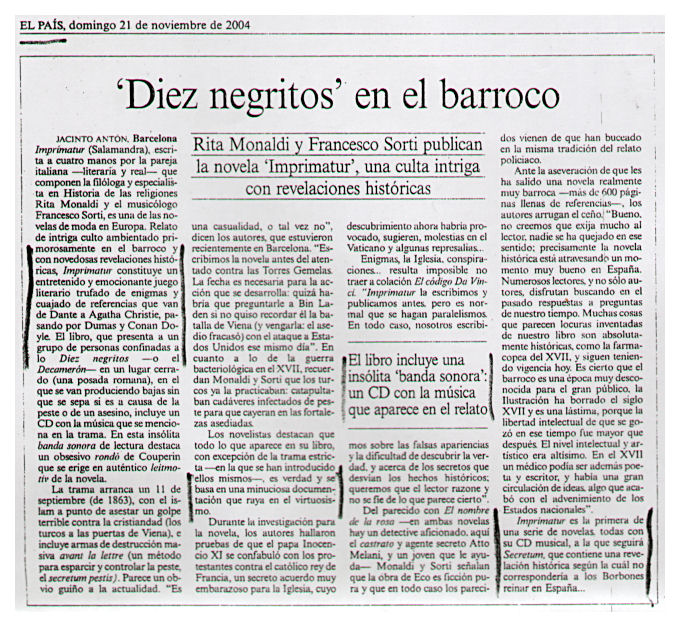
Diez Negritos en el barroco
El Paìs – Domingo 21 de Noviembre de 2004
Jacinto Antón describes Imprimatur as an entertaining, exciting literary game whose riddles recall Agatha Christie, Dumas and Conan Doyle. His El País feature highlights its learned intrigue, unusual musical accompaniment and virtuoso attention to the texture of seventeenth-century life.
No volveremos a publicar un solo libro en nuestro pais
Gaceta de los Negocios, 20 November 2004
La Gaceta introduces Monaldi & Sorti as innovators in historical fiction. In Amanda Mars’s interview, the authors discuss their shared construction of Imprimatur’s complex intrigue and explain how Baroque music becomes an integral narrative device.

Monaldi y Sorti demontan la historia oficial…
El Periódico, 14 de Noviembre del 2004
El Periódico presents Atto Melani as a seventeenth-century James Bond, revived through Monaldi & Sorti’s storytelling. Its feature follows Imprimatur’s nested narratives, the inn servant’s viewpoint and a suspenseful progression of deaths, secret passages and courtly intrigue.

IMPRIMATUR, indagatoria forense: la Europa del XVII, banqueros, reyes y papas
ABC, 13 November 2004
ABC welcomes Imprimatur as a refreshing historical novel and presents Atto Melani as a genuinely fascinating protagonist. Juan Pedro Yániz traces how correspondence, secret communications and the intricate ties between European courts become the foundations of an adventurous fictional world.
Oscuro juego barroco
Historia y vida, November 2004
Historia y Vida calls Imprimatur intelligent and exquisite, praising a novel as Baroque as its setting. Rafael Bladé highlights its hilarious anecdotes, metafictional ingenuity and intricate play of mirrors, likening its narrative effects to Bernini, Caravaggio and Velázquez.

“Imprimatur”: mayùscula filigrana històrica
Qué leer, November 2004
Qué Leer celebrates Imprimatur as a Baroque jewel, praising solid characters, a plot recalling Dumas, Conan Doyle and Christie, and a picaresque narrative voice. Ricard Ruiz Garzón highlights its erudite language, humour and thoughtful exploration of fiction and truth.

Thrillers over pausen en koningen
Haagsche Courant, 13 November 2004
Haagsche Courant introduces Monaldi & Sorti’s thrilling historical fiction through a journey into its Roman settings. Gijs Korevaar highlights the meticulous reconstruction of an entire world, from architecture and meals to the carefully timed journeys used to choreograph the novel’s action.

Vaticaan deed schrijversduo in de ban
Stentor Veluwe, 13 November 2004
Gijs Korevaar’s Stentor profile brings out Secretum’s interlocking narratives, connecting papal succession with the Spanish crown. It emphasises the painstaking detail behind Monaldi & Sorti’s fiction and the narrative framework that carries Atto Melani through Europe’s intricate political world.

Valse noten in de geschiedenis
NRC, 12 November 2004
Bas Mesters describes Secretum as both a gripping detective story and an absorbing portrait of life around 1700. His NRC feature highlights its exuberant language, lifelike characters and vivid world of gardens, music, feasts and political intrigue.

Vaticaan boycott Boekenbeurs-sellers
De Morgen, 9 November 2004
De Morgen introduces Secretum as a notable literary success at the Antwerp Book Fair. Patrick De Rynck places Monaldi & Sorti’s literary thrillers in late-seventeenth-century Rome, following the Dutch-language launch and their growing international readership.

De wereld is één barokke maskerade, page1, page2, page3, page4
De Morgen, 10 November 2004
De Morgen praises Monaldi & Sorti’s sensuous prose and ingenious plotting, finding that Secretum sustains its suspense across seven hundred pages. The review celebrates its variety—philosophy, action, comedy and characterisation—and the stylistic skill that makes its Baroque world so absorbing.


Koninklijk complot in het jubeljaar 1700
Brabants Dagblad, 9 November 2004
Brabants Dagblad praises the peerless way Secretum interweaves reality and imagination. Mieske van Eck follows its gradually unfolding conspiracy and vivid historical particulars, concluding that Monaldi & Sorti make reading about the past an extraordinary and exciting experience.

Anjou was geen wettige troonopvolger!
Trouw, 30 October 2004
Afra Botman praises Secretum as a masterly story, enriched by colourful details of politics, art, religion and the romantic entanglements of an earlier elite. Her Trouw review highlights the impressive abundance and imaginative scope of Monaldi & Sorti’s Baroque world.

Inmersión en el barroco
La Vanguardia, 17 Octubre 2004
La Vanguardia explores Imprimatur’s immersive recreation of Baroque Rome, where a quarantined inn becomes the stage for deception and courtly conspiracy. Monaldi & Sorti describe the sensory precision behind that world, with period customs, food, clothes and music woven into the fiction.

Urbi et Orbi tussen de ruines
NRC Handelsblad, 15 October 2004
Gert Jan de Vries ranks Monaldi & Sorti above Umberto Eco for their richly beautiful prose. His NRC review praises Secretum’s ingenious construction, lively characters, humour and verbal abundance, with special credit for Jan van der Haar’s Dutch translation.

Italiaanse première in Nederland
Trouw, 16 September 2004
Trouw announces the Dutch world première of Secretum, following the literary success of Imprimatur. Pauline Valkenet introduces Monaldi & Sorti’s seven-part historical thriller cycle and records the growing international readership for their seventeenth-century Roman fiction.

2003
Die dunkle Seite eines Papstes
NRZ – Neue Ruhr Zeitung, 20 Dezember 2003
NRZ presents Imprimatur as a lavishly Baroque blend of detective story, political thriller and historical panorama. Recipes, remedies, riddles and music enrich an atmospheric Roman inn, while hidden passages and a web of intrigue keep its characters entangled.

Das dunkle GEHEIMNIS eines Papstes, Titles
Hamburger Abendblatt, 29 November 2003
Hamburger Abendblatt enters Imprimatur’s atmospheric underground Rome, where secret passages and an opulent Baroque setting sustain a political thriller. The article highlights a plot that gradually unveils its characters’ identities and motives, mingling espionage, plague and murder.


Intrigues politico-religieuses…
Vers l’Avenir, 23 Novembre 2003
Vers l’Avenir describes Imprimatur as Agatha Christie enriched by historical erudition: a gripping, enclosed mystery set in seventeenth-century Rome. Its interview follows the authors’ combination of detection, political intrigue and surprising revelations as the characters gradually disclose their secrets.

Von der Schuld des Innozenz
Buchreport, November 2003
Buchreport presents Imprimatur as a church mystery built around dark secrets and an investigation into Innocent XI. Its feature follows the authors’ transformation of documentary discoveries into historical detective fiction, placing a fictional plot around the hidden workings of power.

Rätsel, Ränke und Rankünen …
Luxemburger Wort, 26 November 2003
In Luxemburger Wort’s reading interview, Laurent Schonckert praises Imprimatur’s absorbing murder mystery and vivid portrait of seventeenth-century Europe. Courtly intrigue, medicine, astrology and cookery make history tangible, while suspense gives the period panorama an engaging narrative shape.

Die Schuld des Innozenz
Augsburger Allgemeine Zeitung, 14 Oktober 2003
Augsburger Allgemeine introduces Imprimatur as a fascinating historical novel, opening with a provocative letter to the Vatican before plunging into a quarantined Roman inn. Mysterious guests, underground passages and political intrigue give its Baroque setting the shape of a thriller.

Monaldi & Sorti
Hamburger Morgenpost, 25 September 2003
Hamburger Morgenpost praises Imprimatur’s artful, mathematically precise construction, its clear plot and narrative melody. It singles out the dazzling Atto Melani and the likeable young narrator as a small mystery expands into a political thriller of impressive scope.

Livraisons
Le Monde, 04 avril 2003
Le Monde admires Imprimatur’s narrative audacity and energy, combining a gripping thriller with historical depth. It also praises the inventiveness of its language and Nathalie Bauer’s flavourful translation, which brings the novel’s striking range of registers into French.

Les événements du 11 septembre… 1683, page1, page2
La Presse de Montréal, 16 March 2003
La Presse gives Imprimatur four stars, calling it a complex, engrossing tour de force. It praises the authors’ recreation of the classic English detective novel’s atmosphere, with a Roman inn, suspicious travellers and clues woven into an ambitious historical narrative.


Un polar érudit
Le Devoir, 16 Février 2003
Le Devoir hails a formidable historical thriller, praising its tightly effective enclosed mystery and intelligent, well-balanced erudition. The fresh, lively young narrator gives Imprimatur the energy of a coming-of-age novel within a powerful historical fresco worthy of Umberto Eco.

Rita Monaldi et Francesco Sorti
Le Journal De Québec, 15 Février 2003
Le Journal de Québec calls Imprimatur a fabulous novel poised between learned mystery and historical fiction, in the tradition of The Name of the Rose. Its secret passages, shadowy travellers and Roman intrigue create a richly adventurous reading world.

Plaisir de lire: Imprimatur
Le Journal de Montréal, 1 February 2003
Le Journal de Montréal presents Imprimatur as an immense, erudite novel that invites full immersion. Its teeming cast, Baroque espionage and enclosed mystery recall Agatha Christie, while the authors’ literary ambition prompts comparisons with Umberto Eco.

Boeten voor de wandaden van Innocentius XI
Het Parool, 18 January 2003
Het Parool interviews Monaldi & Sorti about Imprimatur’s blend of fictional framing and historical revelation. The piece also looks ahead to the continuing sequence, whose linked Latin titles extend the books’ fascination with secrets and the elusive nature of truth.

2002
De mysterieuze nasleep van ‘Imprimatur’
Trouw, 20 Dezember 2002
Trouw presents Imprimatur as a successful novel of seventeenth-century Vatican intrigue, then follows an unexpected contemporary mystery. Its sidebar explicitly treats the unfolding events as material for a Monaldi & Sorti plot, reflecting the pair’s association with secrets and suspense.

Les héritiers d’Umberto Eco
L’Exprèss, 18 Dezember 2002
André Clavel salutes Imprimatur as a brilliantly functioning narrative machine, blending the erudite detective novel with historical fiction. He relishes its cascading surprises, dizzying suspense and sumptuous passages on music and gastronomy, invoking Dumas, Verne and Agatha Christie.

Un thriller religieux
Elle, 16 Dezember 2002
Elle praises the way Monaldi & Sorti draw on the full resources of their period to weave an engrossing historical thriller. Art, music and medicine intertwine with suspense, while Atto Melani and his inn-boy companion form a detective partnership.

Des intrigues internationales…
Libération, 12 décembre 2002
Libération commends Imprimatur’s colourful, powerful, taut style and its gripping suspense. Its international intrigues mingle with sharply observed, picturesque characters, drawing readers into a Baroque world of music, painting, medicine and astrology.

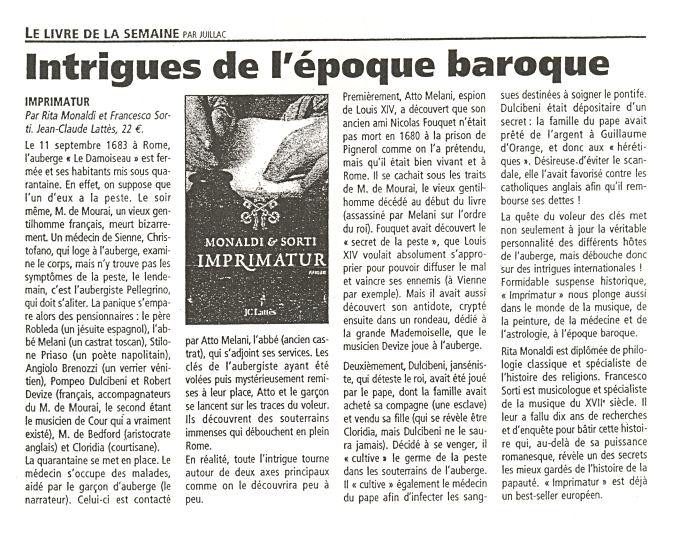
Intrigues de l’époque baroque
Le Télégramme, 1 Décembre 2002
Le Télégramme hails Imprimatur as formidable historical suspense, immersing readers in Baroque music, painting, medicine and astrology. Its intricately connected mysteries and colourful ensemble carry a Roman inn’s closed-room drama into a far-reaching tale of international intrigue.
Imprimatur, un roman de Monaldi et Sorti
Z Livres, Décembre 2002
Bruno d’Epenoux praises Imprimatur’s excellent characters, skilfully sustained suspense and capacity to captivate from beginning to end. He enjoys its nocturnal journeys beneath Rome, macabre comic encounters and adventure storytelling in the tradition of Alexandre Dumas and Eugène Sue.

L’école Eco
DNA, 29 Novembre 2002
Guy Léder welcomes Monaldi & Sorti as gifted newcomers, praising Imprimatur as a gripping historical thriller with an excellent ending. He singles out its ingenuity in giving seventeenth-century intrigue a strikingly contemporary resonance.

Huis clos à la romaine
Figaro-Madame, December 2002
Madame Figaro admires a fascinating, satisfyingly Machiavellian historical intrigue. Monaldi & Sorti weave intersecting confessions into a complex mosaic of secrets, guiding readers through a breathless search for truth populated by distinctive, vividly imagined characters.

Intrigues au Vatican
Le Monde Suppl.
This feature introduces Imprimatur as a breathless historical thriller, highlighting its elaborate narrative frame and political intrigue. It also relays La Stampa’s praise for a captivating plot and prose that envelops readers and carries them along.

“Imprimatur”, un nouveau “Nom de la rose”?
Livres Hebdo, 1 November 2002
Livres Hebdo’s launch feature highlights Imprimatur’s tense closed-room atmosphere and intricate combination of political secrets, coded messages, music and medicine. It also examines the layered manuscript framing and the care taken to recreate seventeenth-century language in French.

L’événement de la fin de l’année
Editions JC Lattès, Novembre 2002
JC Lattès’s French launch announcement presents Imprimatur as a major historical thriller and an end-of-year publishing event, foregrounding the novel’s appeal as historical suspense.

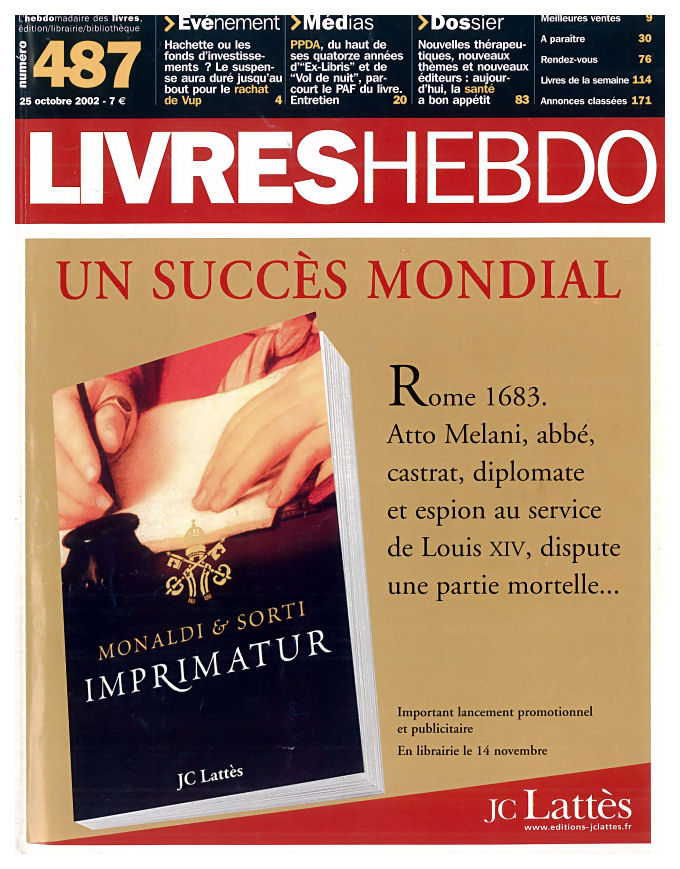
Un succès mondial
LIVRES HEBDO, 25 Octobre 2002
JC Lattès’s launch advertisement on the cover of Livres Hebdo introduces Imprimatur through the suspense surrounding Atto Melani: singer, diplomat and spy in Rome in 1683. It presents this intrigue-driven historical novel as an international success.
Een paus en zijn poen
HP | DE TIJD, 2 August 2002
HP/De Tijd profiles the transformation of historical research into fiction in Imprimatur. Monaldi & Sorti discuss the papal intrigues behind their Roman mystery, linking Atto Melani’s double life to their interest in history’s concealed connections.

IMPRIMATUR is zomerbestseller
Rotterdams Dagblad, 19 July 2002
Wilko Voordouw praises Imprimatur’s sophisticated weaving of fact and fiction, colourful characters, strong plot and suspenseful chases. He singles out the historical medical treatments and kitchen scenes as pleasures that alone justify reading the novel.

Rome 1683: vol duistere intriges
Trouw, 15 July 2002
Laura Padi’s Trouw review finds abundant reading pleasure in Imprimatur’s absorbing intrigue. Its interlocking frame narratives, suspenseful quarantine plot and historical digressions culminate in a resolution that leaves the reader satisfied.

Voorwerp van vaticaanse woede
Het Katern, 21 June 2002
Johan Bakker draws attention to Imprimatur’s musical dimension, including Atto Melani’s arias and Couperin’s Les Barricades mystérieuses. The review welcomes Sorti’s use of his musical gifts within a historical narrative built around a diary and an enclosed Roman inn.

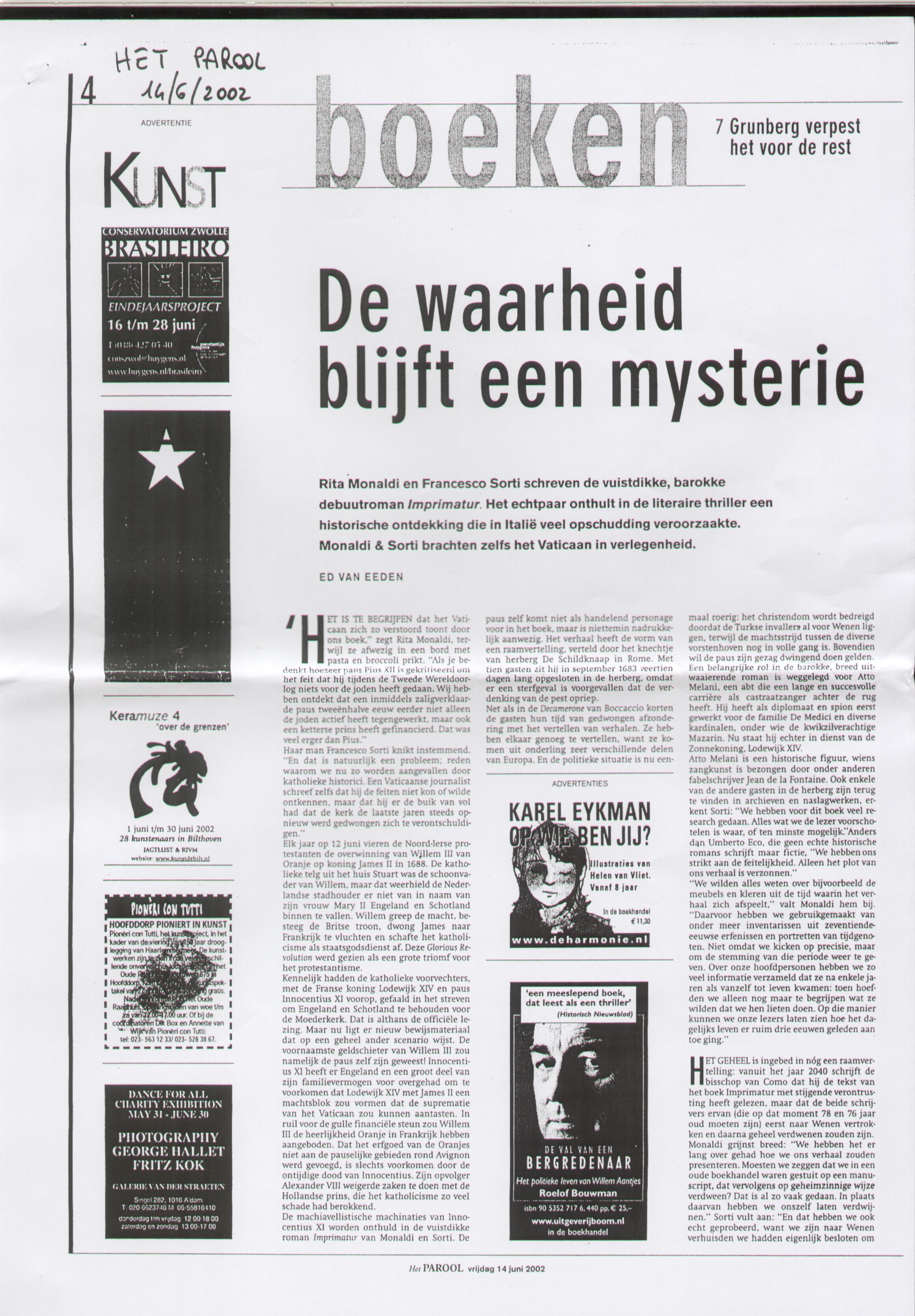
De waarheid blijft een mysterie, page1, page2
Het Parool, 14 June 2002
Ed van Eeden’s interview explores Imprimatur’s layered frame story and vividly recreated everyday life. Monaldi & Sorti describe rewriting each page six or seven times apiece, forging a shared voice in which even they can no longer distinguish their individual contributions.

Wij zijn romanciers, geen historici
Metro, 10 June 2002
In this Metro interview, Monaldi & Sorti explain their aim of conveying the feeling of a past age through fiction. Authentic people, a quarantined Roman inn and the narrator’s discoveries provide the dramatic framework of Imprimatur.

Achtervolgingen in middeleeuws Rome
Eindhovens Dagblad, 2 Juni 2002
Eindhovens Dagblad highlights Imprimatur’s colourful cast, exciting events and chases through Rome. The feature praises the accomplished weaving of fact and fiction, with European history revealed through Atto Melani, the inquisitive inn servant and a carefully assembled narrative puzzle.

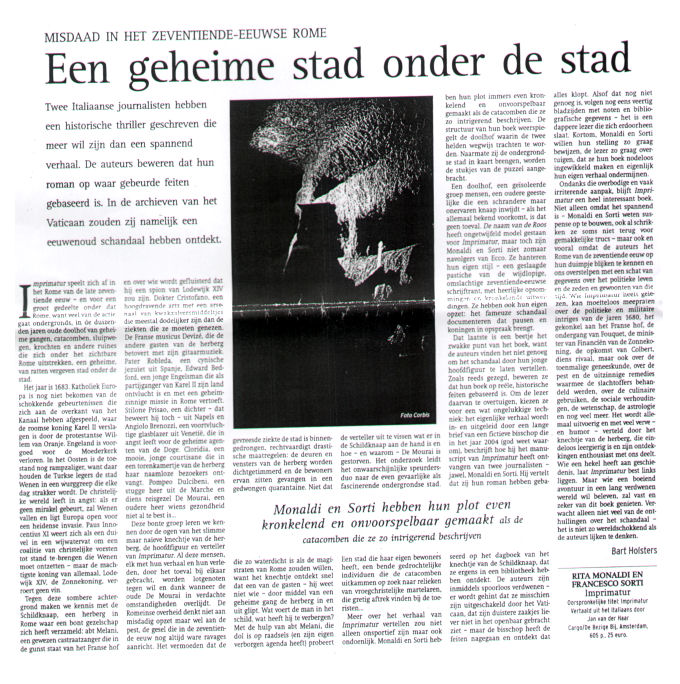
Een geheime stad onder de stad
De Morgen, 10 Juli 2002
De Morgen praises a plot as winding and unpredictable as the Roman catacombs the authors describe so intriguingly. Beneath the murder mystery, secret passages and concealed motives turn seventeenth-century Rome into a labyrinth of narrative suspense.
2001
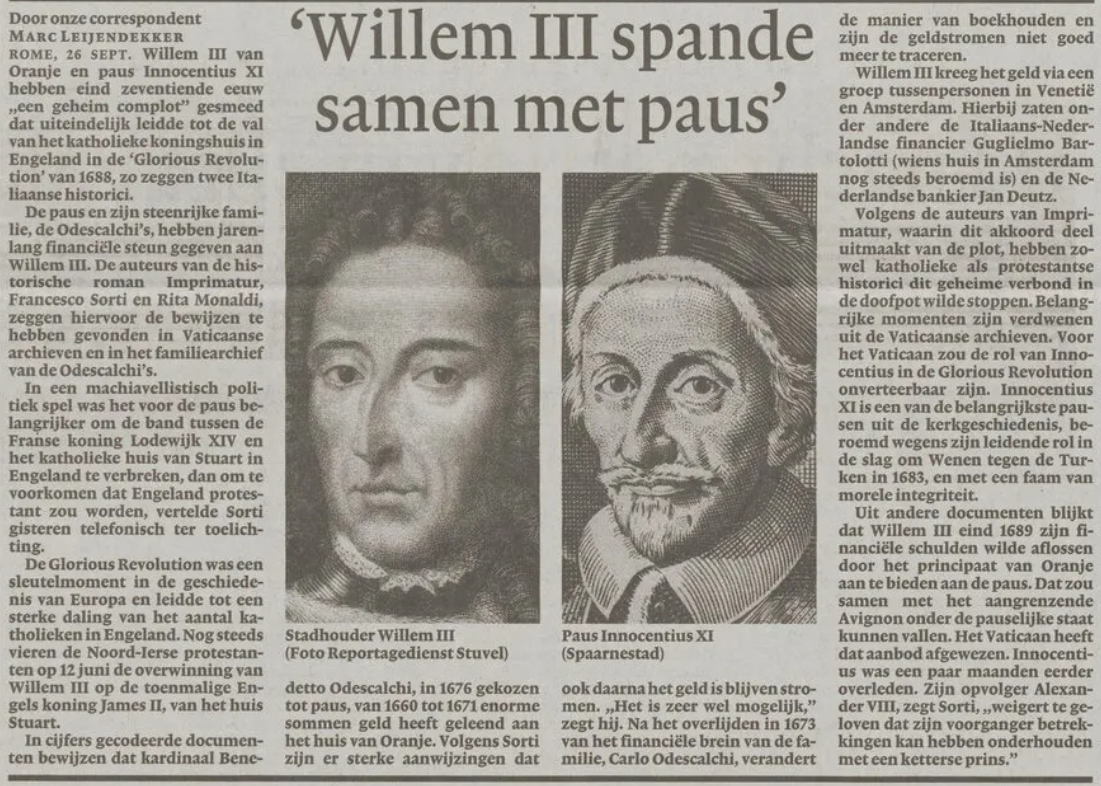
Willem III spande samen met paus
NRC Handelsblad, 26 September 2001
Historical background to Imprimatur: NRC Handelsblad reports on coded financial records connecting the Odescalchi family with William of Orange. The archival investigation supplies context for the secret diplomacy and shifting allegiances that inform Monaldi & Sorti’s fiction.
William of Orange “funded by the Pope”
The Sunday Times, 23 September 2001
Historical background to Imprimatur: John Follain reports on financial links between Pope Innocent XI and William of Orange. This early account of the archival investigation illuminates the European power struggles and divided loyalties behind the novel’s world.
